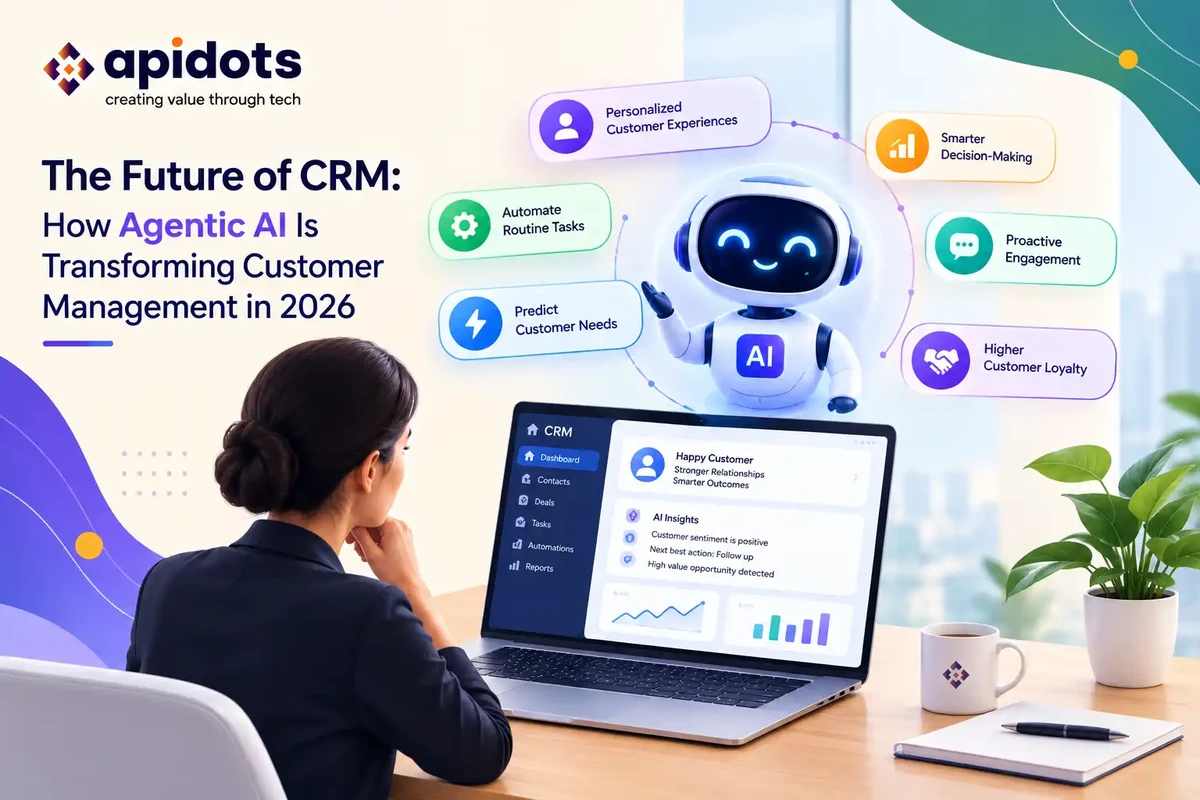
Enterprise revenue operations in 2026 run on coordinated multi-agent architectures that execute cross-functional workflows independently without manual chat prompts. Modern CRM platforms connect sales, marketing, and customer support directly into an active decision engine. Executive priorities reflect this transition, with 86% of C-level decision-makers identifying AI agents as essential to strategic goals over the next two to three years, targeting operational cost reductions of up to 60% and lead volume growth exceeding 50%.
The Shift to Multi-Agent Architectures and Measurable ROI
The future of AI-powered CRM centers on autonomous multi-agent systems that coordinate complex revenue tasks across departments without human handoffs. Research firm Forrester projects this evolution as a move away from isolated, role-based AI toward multi-agent frameworks where specialized agents collaborate to handle multi-step processes. As monday.com outlines, copilots help individual team members move faster, agents help teams scale, and multi-agent systems remove cross-departmental coordination friction entirely.
Enterprise procurement teams in 2026 evaluate CRM platforms on verified financial output and operational efficiency rather than standalone feature lists. Creatio documents that AI adoption metrics now focus on documented time savings, lower expenses, and overall output gains. McKinsey reports potential call time reductions reaching 70% following agentic deployments, while the market for industry-specific AI agents maintains an expected compound annual growth rate above 35%. As Burley Kawasaki, Global VP of Product Marketing and Strategy at Creatio, notes: “Agentic automation is not simply another technology trend. It is the foundation of how enterprises will innovate, compete, and grow in the AI Economy.”
Decision-making logic has shifted away from static, trigger-based rules. Traditional CRM automation depends on manual parameters, such as dispatching a templated email three days after a product demonstration. In contrast, 2026 AI CRM platforms evaluate behavioral patterns across thousands of deal interactions to predict pipeline outcomes and prescribe dynamic next-best actions. This architecture connects sales, marketing, support, and finance into an active execution layer that updates forecasts and shifts resources automatically as buyer signals change.
How Autonomous Workflows Reshape Daily Sales Operations
AI-powered CRMs transform daily sales operations by automating administrative burdens so account executives spend their working hours directly engaging qualified buyers. Salesforce State of Sales data indicates that traditional sales representatives spend 60% of their working hours on administrative duties, leaving only 40% for active selling. In 2026, autonomous sales agents like Lexi in monday CRM handle top-of-funnel lead sourcing, initial qualification, and outbound outreach across SMS and voice channels. This autonomous prospecting feeds directly into dynamic opportunity scoring, which ranks incoming accounts by historical conversion probability to increase lead conversions by up to 40%.
Gartner research shows that AI tooling saves individual sellers an average of 4.8 hours per week, primarily by eliminating 65% of manual CRM data entry. Teams that reinvest this recovered capacity into direct prospect conversations are 2.2 times more likely to exceed customer growth targets. A standard daily routine for an enterprise account executive reflects this shift across four key operating phases:
- 08:30 – Autonomous Pipeline Review: The seller opens the CRM dashboard to inspect twenty inbound leads sourced and qualified overnight by autonomous agents. Each account arrives pre-enriched with firmographic data, verified buyer intent scores, and priority rankings based on conversion likelihood.
- 10:00 – Pre-Call Intelligence Preparation: Before discovery calls, the seller reviews auto-generated meeting briefs in Deal Insights within monday CRM. The platform synthesizes recent stakeholder interactions, extracts key pain points from prior email exchanges, and generates prospect-specific talk tracks and customized objection scripts.
- 14:00 – Dynamic Follow-Up Generation: Following afternoon product demonstrations, generative CRM tools draft tailored follow-up emails, pricing proposals, and customized implementation outlines matched to topics discussed during the meeting.
- 16:30 – Hands-Free Record Synchronization: The CRM conversational intelligence engine transcribes call recordings, extracts action items, updates opportunity stages, and logs contact details directly into the pipeline without manual entry.
Sellers who save 4.8 hours per week across a five-day schedule gain nearly one full hour of customer-facing selling time each day (4.8 hours ÷ 5 days = 0.96 hours per day). Directing this recovered time into strategic pipeline execution enables sales reps to compress deal cycles while maintaining complete record accuracy across enterprise accounts.
Applying Shared CRM Intelligence Across Marketing and Success
Marketing and customer success teams use shared AI CRM intelligence to replace static campaigns and reactive ticketing with continuous behavioral personalization and predictive retention workflows. Marketing teams configure dynamic segmentation engines that update audience parameters automatically based on customer engagement history, product telemetry, and content interactions. Generative CRM modules then draft individualized cross-channel messages, recommend tailored product offerings, and trigger automated nurturing sequences the moment high-intent buyer behavior occurs.
Customer success teams work through proactive account health monitoring and early issue detection. Within monday CRM, teams apply modular AI Blocks to run automatic sentiment analysis across customer communications and categorize incoming support requests without manual triage. When the system detects declining usage patterns or negative sentiment signals, it alerts customer success managers to intervene before service friction escalates. Automated issue prediction surfaces relevant knowledge base documentation and suggests remediation steps, helping teams address account risks early.
Predictive churn risk scoring identifies accounts vulnerable to cancellation, which decreases customer attrition by up to 30%. At the same time, automated health scoring flags accounts demonstrating strong usage adoption, signaling qualified expansion opportunities for account managers. Coworker AI emphasizes this unified operational approach: “The best CRM automation tools don’t just follow rules, they use AI to make decisions, connecting sales, marketing, support, finance, and operations into a single, intelligent workflow engine.” Synchronizing these operational signals across marketing, sales, and service ensures that revenue teams maintain high lifetime customer value while eliminating data handoff gaps across the entire buyer journey.